
|
|
Center for Astrophysics |
- The Variables (Brief summary of the variables in the GCE model, used in our code).
- Variable Descriptions and Limits. (More details on the variables and their astrophysical and software derived or inferred limits).
- The GCE code input form.
- Advanced form; Link to follow when available...
Page Links
This page exists to enable the reader to study the inputs for the GCE model. The first table gives a list of the variables, including units. The secound table provides a more indepth description of the variables and their limits. For the generic reader, it is advised that you follow the sections below on this page, before proceeding to the input form to run the GCE code.
On this page:
On related pages:
- The GCE code runs through the variables, assuming a galaxy evolving
from the intergalactic medium, and undergoing two major changes (e.g.
starbursts, such as due to a merger event) at times TCHANGE1 (T1) and
TCHANGE2 (T2) (with the time between perhaps accounting for the
summed effect of other such events).
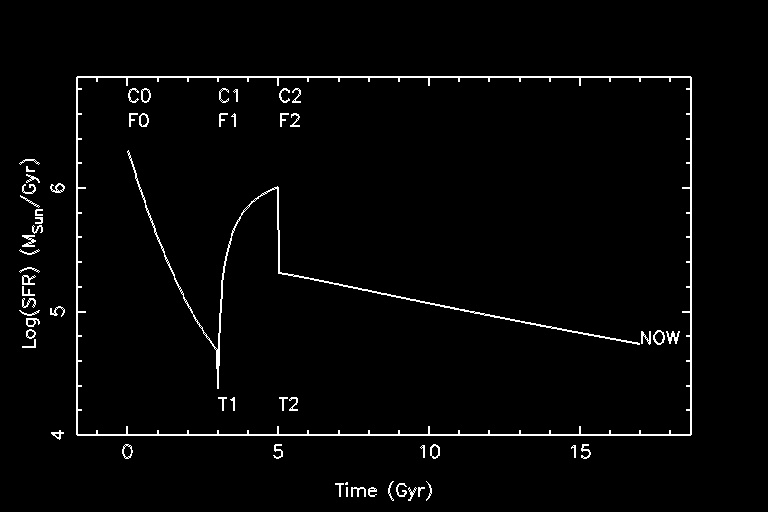
An example graph of star formation rate (SFR) vs. time.
| Variable | Short Description | Units |
|---|---|---|
| NRR | Number of radial ranges modelled in the galaxy. Default is 1. |
N/A |
| AL | This is the index in the Schmidt law, for the SFR. |
N/A |
| ROOC0 | The number “c” which serves as the coefficient of the star formation rate | Gyr-1Vol-1, where AL is 1 |
| RCRIT | Density of the ISM below which the SFR goes to zero. |
M¤Gyr-1Vol-1
|
| FLOSSLIM | Limit for significant mass loss. (Fraction) | M¤ |
| SNIA_RATE | The rate of SN1A in a galaxy. | M¤-1Gyr-1 |
| DT |
This is the time step limit set for the GCE, currently set by SNII. |
Gyrs |
| FLOWRATE0 | The inflow rate, into the ISM, from the intergalactic medium. | M¤Gyr-1 |
| SNII | The upper mass limit, considered for SN II events | M¤ |
| AM | Index for Initial Mass Function (IMF). (Default is Salpeter). | N/A |
| TYPIMF | For IMF: S=Single slope IMF, is default. M=Modified IMF. | N/A |
| SSPDATA | The SSP data set used, to model spectral indices. | N/A |
| X0 | The initial H mass fraction in the ISM gas. | N/A |
| Y0 | Initial He fraction in gas | N/A |
| Z0 | Initial metal fraction in gas | N/A |
| TCHANGE1 | 1st discrete time change | Gyr |
| ROOC1 | 1st changed SFR constant | Gyr-1 |
| FLOWRATE1 | 1st changed inflow rate | M¤ Gyr-1 |
| TCHANGE2 | 2nd discrete time change . | Gyr |
| ROOC2 | 2nd changed SFR constant, which is used from time T2. | Gyr-1Vol-1 |
| FLOWRATE2 | 2nd changed inflow rate | M¤Gyr-1 |
| RICH | Enriched inflow yes (Y) or no (N). The default is Y. | N/A |
| BHMASS | Mass of CO core for BH formation. | M¤ |
| TIME | Time since stars started forming . The default is 17 Gyr. | Gyr |
Description and Limits of Variables
Input |
Description |
|---|---|
|
NRR |
Upper and lower limits each= 1; for single zone models only. |
|
AL |
Upper limit =2; Lower limit= 1 
|
|
ROOC0 |
The number “c” which serves as the coefficient
of the star formation rate .The SFR also depends on the gas density,
in the Schmidt law (Kennicut, R., 1998) as: SFR=
cpa, where a = 1 and p=
density of ISM. A threshold value in the SFR may be reached
(see RCRIT); Then, SFR
fails completely, to make a hard lower limit of 0. A hard upper limit could
be set by the laws of thermodynamics regarding
an singular open system at 1 (i.e. which assumes continuous
inflow into a radial zone). Where mergers of systems occur, this value
may be higher than one, however (for two spirals, 2 for example).
In most models this co-efficient varies between 2 and 0.2, which should provide reasonable upper and lower limits (e.g. Matteucchi & Recchi, 2001). A SFR co-efficient of 4 (assuming a galaxy such as our Galaxy, with diameter of 50 kpc and scale height of ~400 pc) may be reasonable for early on in the evolution of a galaxy. Limits could be: Upper limit=4; Lower limit=0. |
|
RCRIT |
This is the density of the interstellar medium (ISM) below which the SFR goes to zero. An absolute hard limit would be zero. A hard upper limit here should be no less than the Jeans mass for a given ISM density and temperature. Upper limit=N/A; Lower limit=10 M¤ pc -2 (from Elmegreen,1999). |
|
FLOSSLIM |
Limit for significant mass loss. (Fraction) From current research, a lower limit of 0.1 (10 % of each star’s mass) is required if an effect is to be had on the density of the ISM. A hard upper limit could come from considering the fraction of matter in a galaxy that constitutes stars, and detectable changes in the amount of mass in the ISM. Upper limit=? (hard: 1) ; Lower limit = 0.1 (hard limit=0) |
|
SNIA_RATE |
The rate of SN1A in a galaxy. In the current GCE
code (Sansom & Proctor, 1998) the SN Ia rate is 3.8 x10⁻⁵
Gyr-1 M¤-1.
This value was derived from the models of Timmes, Woosley &
Weaver (1995), assuming a Galaxy mass of 1.4 x10¹¹ M¤.
In summary SN Ia, which dominate supernovae events in early-type
galaxies, appear in models and observations to have a similar rate
of between 4.1 and 11.8 Gyr-1 M¤-1x10⁻⁵
(in the local Universe). At larger redshifts, slightly higher
SN Ia rates have been observed and fed through cosmological models
to derive a rate of 10.4 Gyr-1 M¤-1x10⁻⁵.
These values are converted from SNu assuming a value of 7.4 x
1010 M¤ and a mass-to-light ratio of 3.4
(Carroll & Ostlie, 1996, table 22.1).
However, a hard upper limit could be derived if half the star systems, about 2/3 of the stars in the galaxy, went SN1A inside of a single Gigayear (unlikely). Upper limit=11.8; Lower limit= 3.8 Gyr-1 M¤-1x10⁵ . |
|
DT |
This is the time step limit set for the GCE. However, the lower limit is currently set by the GCE code. The time step may be decreased, based on observations of type II supernovae delayed feedback into the ISM. The delay time between leaving the MS and the supernovae explosion, and dispersion of material into the ISM, is of the order of 104 years. As a side note, the SNR is thought to last about 20 thousand years, after which time it is considered to have dispersed. Upper limit=0.03 (hard upper limit must be less than TCHANGE1); Lower (hard) limit=0.01. |
|
FLOWRATE0 |
The initial inflow rate, into the ISM, from the intergalactic medium. We arbitrarily assume an initial mass of 106M¤.for the model galaxy. In the case of a merger, or even the effects of a close encounter, the inflow rate might be as high as 106 M¤Gyr-1 ! This is based on recent simulations . It may be more of the order of a 100 thousand. A galaxy is expected to overall accrete matter, in its lifetime. Upper limit=107 ; Lower limit= 105 (hard limit=0). |
|
SNII |
The upper mass limit, considered for SN II events. Stars beyond this size may exist, but are considered too rare to effect the chemical abundances significantly, during the evolution of a galaxy. There is a default lower mass limit, which is set in the code at 8 M¤ (Regally, 2001). < /SPAN> Upper Limit=120 Msun, Lower Limit= 70 |
|
AM |
Index for Initial Mass Function (IMF). (Default is Salpeter ), O bservations of bulges may be relevant to spheroidal galaxies, which have generated indexes to the Salpeter IMF as high as 2.35 in spheroidals (Zoccali et al, 2001). Work has been done to investigate the validity of any IMF over the existing simple Salpeter IMF; in a study of the uncertainty inherent in any observationally deduced IMF invalidates much evidence for a variable IMF (Kroupa, 2001). These uncertainties arise from Poisson statistics of detections and stellar dynamics (such as systematic errors due to some stars being unresolved binaries). As a side note, the MFs in globular clusters appear to be, on average, systematically flatter than the Galactic-field IMF deduced in Kroupa (2001). Soft limits then may be: Lower=1 Upper=2.35. |
|
TYPIMF |
For IMF: S=Single slope IMF, is default. M=Modified IMF. The Salpeter IMF is further discussed on the GCE Research page. |
|
SSPDATA |
The SSP data, used to model spectral indices: W=Worthey94 V=Vazdekis99. These refer to papers written detailing modelled spectral indices, for SSPs as discussed further on the GCE Research page . |
|
X0 |
|
|
Y0 |
|
|
Initial metal fraction in the ISM gas. |
|
|
TCHANGE1 |
|
| TCHANGE2 | 2nd discrete time change. |
|
ROOC2 |
|
|
FLOWRATE2 |
|
|
RICH |
|
|
BHMASS |
Mass of CO core for BH formation. Currently, this is of the order of 8 solar masses. |
|
TIME |
|

|

| Date Last Modified: 29/04/03 | Web author: Mark Northeast (MSNortheast@uclan.ac.uk). |