
Speaker: Indranil Banik
Date: 30th September 2026
Title: Can a Cosmic Void Get Cosmology Out of its Hole?
Abstract:
The standard cosmological model is facing a serious challenge known as the Hubble crisis. When observations of the infant Universe are combined with the physics of the Big Bang, the model predicts that the Universe today should be expanding at 67 km/s/Mpc, implying a cosmic age of 13.8 billion years. However, direct observations of the nearby Universe consistently suggest a significantly faster rate of around 73 km/s/Mpc, implying a younger universe. This highly statistically significant discrepancy has become one of the most important problems in cosmology. In this talk, I will explore the possibility that it arises because the Milky Way lies inside a vast underdense region, or cosmic void. If we are sitting inside such a ‘hole’, the outward gravitational pull from surrounding matter would naturally trick us into overestimating how fast the rest of the Universe is expanding. Recent observations, including the observed ages of old stars and globular clusters, have shifted attention toward explanations that favour the lower early-Universe value globally (Arxiv:2607.00764). By anchoring physics to the early Universe via baryon acoustic oscillations frozen into large-scale structure since high redshift, we can use Type Ia supernovae to chart the expansion history down to redshifts below 0.1, then extrapolate to the present epoch. This inverse distance ladder results in 77 +/- 3 km/s/Mpc, which exceeds the early Universe estimate but is compatible with the high expansion rate obtained from the standard distance ladder – despite not using it. I will explain the secret to this recent groundbreaking result. The late Universe nature of the solution to the Hubble tension makes the cosmic void hypothesis more promising than it has ever been. In short, I will explore whether placing ourselves in a cosmic hole might be the key to getting cosmology out of one.
Speaker: Cristiano Longarini
Date: 7th October 2026
Title: Rethinking gravitational instability in planet-forming discs
Abstract:
Protostellar discs are the birthplaces of planets, and ALMA now allows us to watch this process in real time. Its observations reveal discs that are far from simple: rings, gaps and spirals are ubiquitous, and there is growing evidence that planet formation is already under way in the earliest, most massive phases of disc evolution. In this regime, the disc’s self-gravity can no longer be neglected.
In this talk I will revisit gravitational instability (GI) and argue that it plays a more crucial role in protostellar discs. First, I will discuss GI as a mechanism for angular momentum transport, showing how self-gravitating turbulence shapes the structure of young discs and how its kinematic signatures can be used to probe their dynamics. Second, I will revisit GI as a route to planet formation, considering its interplay with dust dynamics. The aerodynamical coupling between dust and gas, combined with the disc’s self-gravity, allows solids to collapse directly into planetary cores. This hybrid planet formation scenario overcomes the timescale problem of the classic core accretion scenario, offering a fast way to form planetary cores. Finally, I will place GI in the broader context of star formation, investigating the role of mass transfer from the parent cloud to the disc. Far from being a theoretical curiosity, GI emerges as a key process connecting disc formation, evolution and the first steps of planet formation.
Speaker: Luke Holden
Date: 14th October 2026
Title: Investigating the role of AGN outflows in galaxy evolution with large spectroscopic surveys
Abstract:
Outflows of gas accelerated by accreting supermassive black holes in galactic centres (active galactic nuclei, or AGN) are thought to play a crucial role in regulating the star formation of their host galaxies, and are therefore an important aspect of galaxy evolution. Despite much progress in this field, the exact mechanisms by which AGN accelerate gas outflows remain uncertain, a situation which is further complicated by different AGN types having different forms of dominant energetic output. Moreover, there are significant uncertainties involved in calculating the key parameters needed to quantify the impact of outflows on their host galaxies. In this talk, I will present the techniques we have developed to determine outflow acceleration mechanisms and impacts accurately for different AGN types, and discuss how, by combining these with data from large spectroscopic surveys, we can determine the true role of AGN-driven outflows in galaxy evolution.
Speaker: Lana Williams
Date: 21st October 2026
Title: Do Solar Energetic Particle events impact lower-atmospheric temperatures on Mars?
Abstract:
In this seminar, I will give an overview on Mars’ coupling to the space environment and explore a case study that addresses the relationship between Mars’ lower atmosphere and solar transients. Due to its solar proximity, absence of a strong, global planetary magnetic field and its thin atmosphere – Mars is sensitive to the impacts of external influences such as solar energetic particles (SEPs). Produced during solar flares and coronal mass ejections, SEPs are high-energy and comprised of protons, electrons, and heavier ions. Previous work has shown that SEPs result in diffuse aurorae, fluxes in surface radiation, disruption of radio propagation, the dispersion of atmospheric compounds, and the ionisation of atmospheric layers. Paying attention to Mars’ climatology, the relationship between SEP events and lower-atmospheric heating at Mars is investigated. Five SEP events of four days or longer were identified in the years 2018-2021. Utilising data from The Mars Atmosphere And Volatile EvolutioN mission (MAVEN), the Trace Gas Orbiter (TGO), AMDA (Automated Multi-Dataset Analysis), and the Mars Climate Database, Mars’ lower-atmospheric temperature profiles before, after and during each SEP event are analysed. No strong evidence was found that SEP events lead to the heating of Mars’ atmosphere. However, in the case of June 2018, an SEP event occurred concurrently with an expanding global dust storm; here clear heating effects were observed. Further research is required to attribute the observed atmospheric temperature variations to the global dust storms and SEP events where the two occur simultaneously.
Speaker: Johannes Courtial
Date: 4th November 2026
Title: Pixel-based adaptive optical devices, a new angle on autostereograms, visualising relativistic distortion using the lookalike sphere (and lots of playing with interactive web apps)
Abstract:
First of all: I will not pretend that these topics are related by anything other the fact that my group wrote web apps (which don’t require installation) that allow interactive experimentation of these topics. Secondly, I am very much hoping to make you play with these web apps during my talk, so bring a suitable device (laptop, tablet, smartphone, even VR headsets, in all cases connected to the internet).
Pixel-based adaptive optical devices are currently my main area of research. This (scientifically) relatively nutritious topic will form the main course of my presentation. I am going to describe one particular example: a combination of two refractive components which are designed such that they act like a lens whose focal length depends on the relative rotation angle between the components. The pixellation compromises image quality, but allows the lens to be smaller and lighter, making it attractive for SWaP-C applications (which emphasise Size, Weight, Power, and Cost).
The first presentation pudding will be a generalisation of autostereograms, aka “Magic-Eye pictures”, which allow viewers to see 3D scenes in 2D patterns (usually of dots). Our generalisation started with the idea of designing these such that the same autostereogram, when rotated by different angles, encodes different 3D scenes; in our wildest dreams we went as far as imaging spinning autostereograms showing 3D movies. We completely failed to create anything resembling a movie, but we did manage to create autostereograms that encode three different 3D scenes.
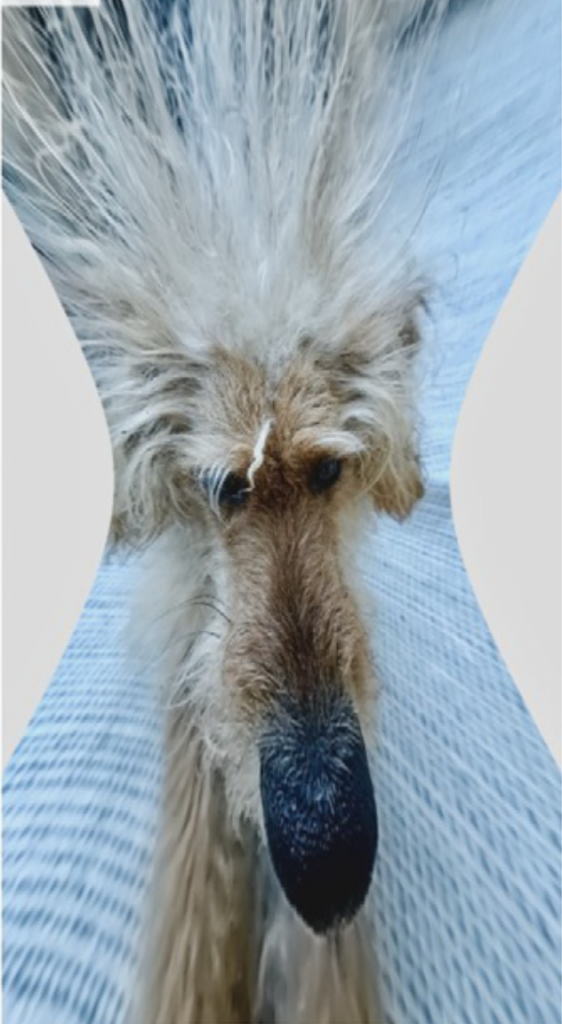
Second presentation pudding is relativistic distortion: the apparent distortion of a scene moving at relativistic speed relative to an observer. I will explain the origin of relativistic distortion, and how a simple calculation suggested a new concept for visualising relativistic distortion: the lookalike sphere. The picture shows my family’s relativistically distorted (using the lookalike sphere) dog Charlie.
I am hoping to inspire others to illustrate their research with interactive software, especially now that AI makes it much easier to do so!
Speaker: Dr Clive Elphick
Date: 11th November 2026
Title: Uses of AI to Prove and Refute Some of My Maths Conjectures
Abstract:
The use of AI to transform maths is making newspaper headlines on a weekly basis. For example, in September OpenAI proved a singularity in the Navier-Stokes equation, and in October OpenAI published 722 papers on one day, including a fairly short proof of the quasi-Riemann hypothesis. In this talk I will describe some of these recent developments and talk about the use of AI this year in proving and refuting some of my maths conjectures. I will conclude with some thoughts on future uses of AI in maths, which I hope will lead into a discussion with the audience about the uses we are all making of AI today and in the future.
Speaker: Professor Catherine Heymans
Date: 20th November 2026
Title: Cosmology: How a quest to “nail down some numbers” has morphed into an astrophysical study of the formation and evolution of stars, galaxies and AGNs.
Abstract:
“Why are you wasting your time measuring those numbers to ever higher precision? Face it Catherine, cosmology is done!” *
Ah, if only! In this talk I’ll share how, as we’ve improved the precision measurement of the cosmological parameters that define our Universe, we’ve found ourselves faced with more questions than answers.
In an era of “tension” between results that should be complementary, cosmologists are being challenged to master new trades: from the operational intricacies of charge-coupled devices (CCDs), to the complexities of stellar evolution and galaxy formation combined with a necessity to understand how powerful active galactic nuclei (AGNs) re-distribute dark matter across the cosmos. These diverse research areas in astrophysics now all play a crucial role in our quest to understand the nature of the dark components that make up our Universe.
Join me to explore the challenges and excitement that lies in store for the cosmology community thanks to the deluge of data from Euclid, the Vera Rubin Observatory, JWST and the Dark Energy Spectroscopic Instrument.
* Quote from a dear colleague in the exoplanet community!
Speaker: Professor Isobel Hook
Date: 25th November 2026
Title: Supernova cosmology with Euclid, Rubin and TiDES
Abstract:
In this talk I will discuss recent results and upcoming prospects for observing distant supernovae. I will begin with a brief review of previous supernova surveys and the use of Type Ia supernovae in cosmology. Recent results suggest that the properties of dark energy may be changing with time, in contrast to the cosmological constant explanation for dark energy. This provides new impetus for improving our measurements of the cosmological parameters. I will describe prospects for supernova observations from the Time Domain Extragalactic Survey (TiDES) which will use the 4MOST instrument to obtain spectra tens of thousands of supernovae and their host galaxies discovered by the Rubin Observatory’s Legacy Survey of Space and Time (LSST). I will also describe some early results and prospects for supernova science with the Euclid mission, and discuss how the combination of Rubin/LSST, TiDES and Euclid will advance supernova cosmology.
Speaker: Professor Ian Robson
Date: 2nd December 2026
Title: Observatory Wars: the demise of the two Royal Observatories (there’s never enough money!)
Abstract:
This talk describes some 45 years of the funding (or lack of it) for UK astronomy that eventually led to the demise of both the Royal Greenwich Observatory and the Royal Observatory Edinburgh through ‘Observatory Wars’. This all came about due to the need to save money and the ever-present tension between university grants, ongoing projects, the two Royal Observatories and the desire for new projects. Does this sound familiar today? The talk will also be interspersed with ‘interesting’ anecdotes from my ‘Confessions of an Astronomer’ talk.