Foucault Pendulum
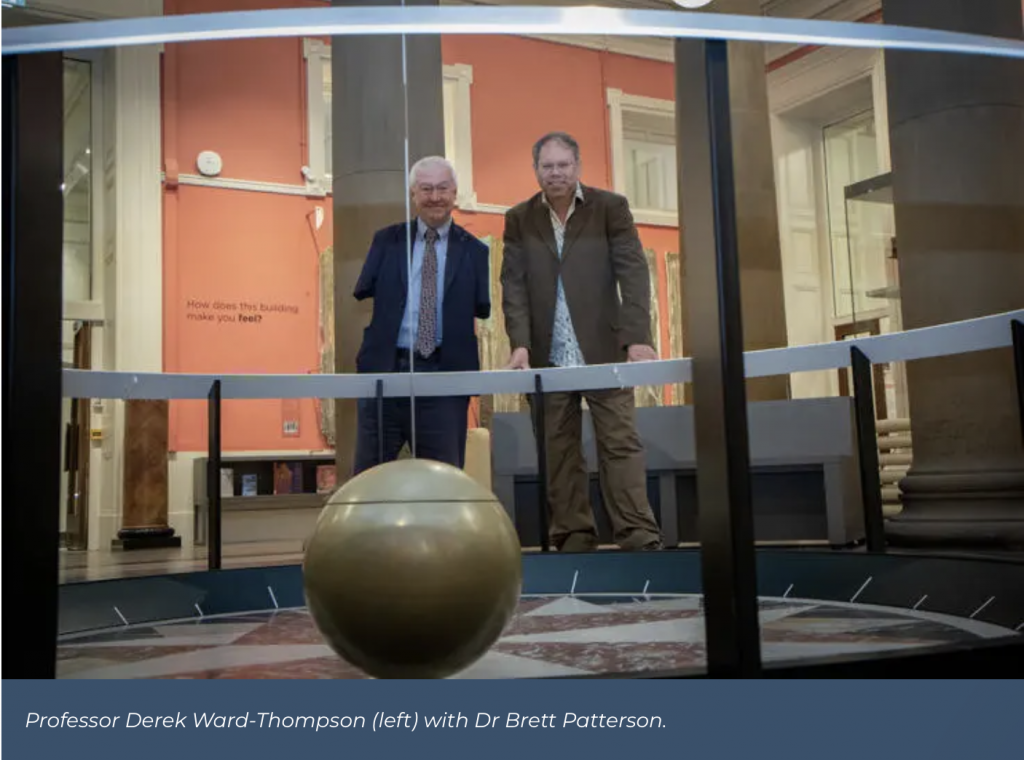
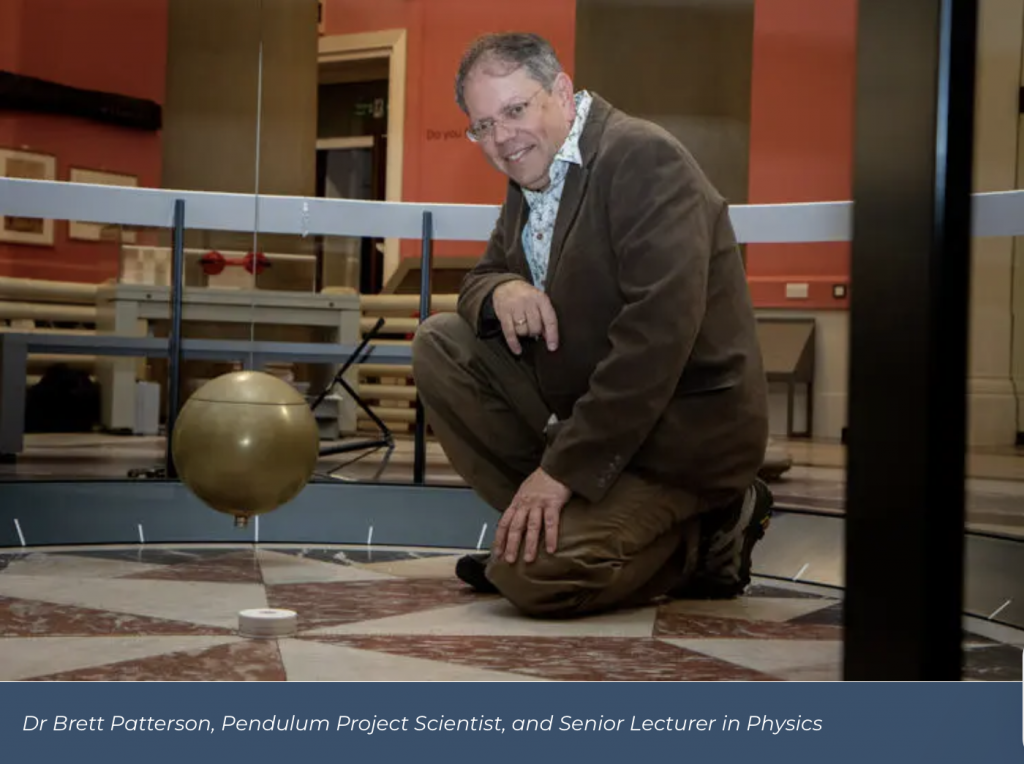
Dr Brett Patterson and Prof Derek Ward-Thompson
University of Lancashire
Please complete this VERY SHORT survey about your experience:
 Foucault Pendulum @ The Harris – Fill in form

- What is it?
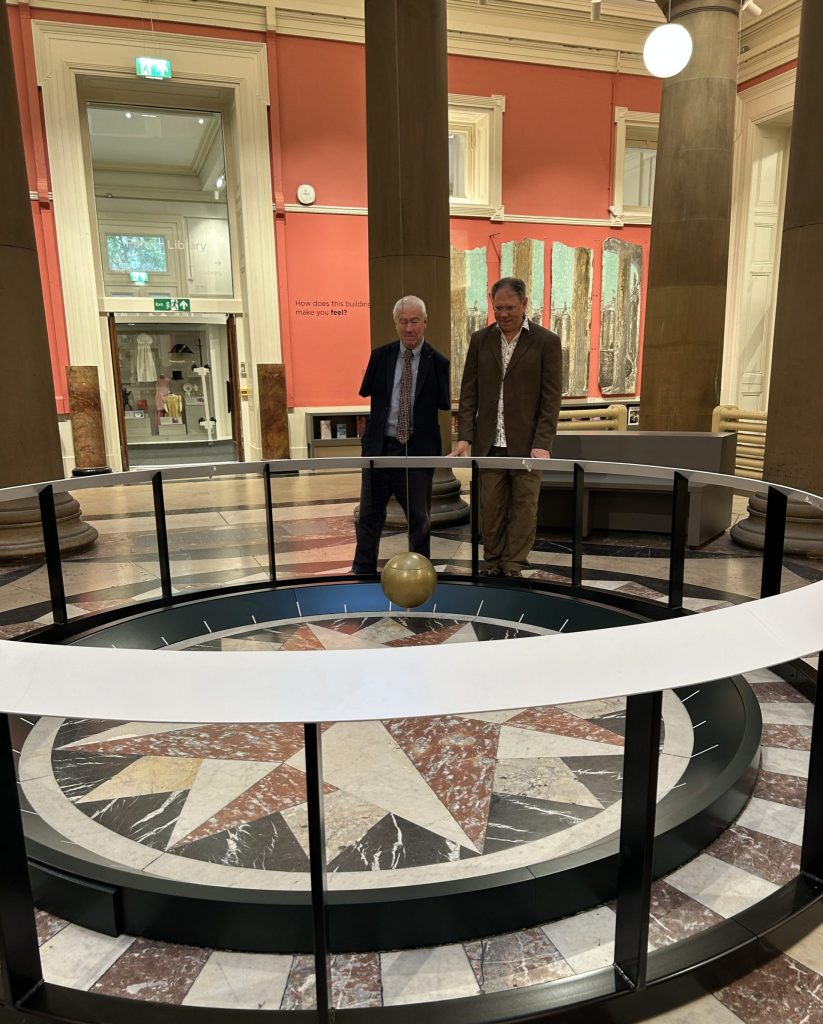
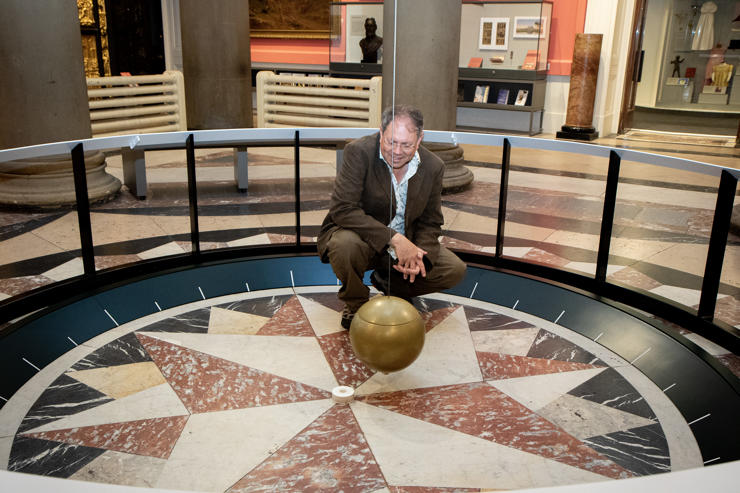
The Foucault Pendulum consists of a 30-kg bob hanging by a 35-m steel cable from a pivot attached to the framework of the lantern window at the apex of the cupola of the atrium of the museum building. What makes it a “Foucault” pendulum is that the bob can swing freely in any direction.
The pendulum swing zone is surrounded by a black ring on the floor with a scale of white tick marks, and there is a viewing fence around that, with a white ring at waist height for leaning on. The pendulum swings across a central black pedestal.
- What does it do?
When the pendulum is swinging, it takes 12 seconds for the bob to swing away from one side, come to a stop at the far side, and then return to where it started.
In addition, the direction of the swinging of the pendulum appears to slowly rotate. This motion is called precession, and it is due to the rotation of the Earth. In other words, the pendulum demonstrates the rotation of the Earth. The pendulum appears to rotate clockwise when viewed from above.
The rate of rotation depends on the latitude of the location. At Preston, 53° N, the rate is 12° per hour. That corresponds to approximately the distance between two white tick marks on the black ring each hour (or about 4 cm of movement every 10 minutes).
- Why doesn’t it stop?
If left to itself the pendulum would eventually stop swinging due to air resistance and friction at the pivot. This is what happened with the previous Harris pendulum. For the new pendulum it was decided to design a pendulum that wouldn’t stop.
There are some very strong magnets on the bottom of the bob and there are two coils of wire under the central black pedestal, a sense coil and a driving coil, with copper wires running over the floor to either side to the black ring. Inside the black ring, behind a removable access panel, there is a coil control circuit box and a battery.
The coils enable the circuit to sense when the pendulum passes over the centre, and toprovide a little push to the pendulum to keep it going.
Note that this mechanism has nothing to do with the pendulum rotating.