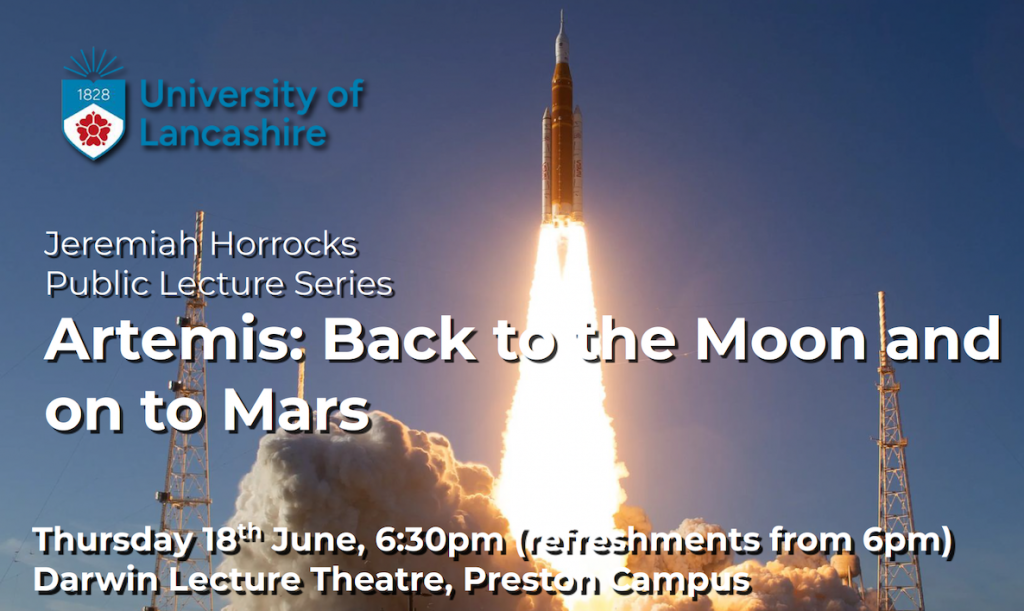
More than 50 years after the first 12 humans set foot on the Moon, NASA, China, and the European Space Agency (ESA) have plans to put people back on the Moon in the next few years. The NASA program is called Artemis; the Chinese program is Chang’e; and the ESA program is Argonaut. The Artemis program has the goal of using the Moon as a stage for humans en route to Mars. What adventures! But is there anything beyond this? The Moon and Mars promise great scientific returns, but with the rapid advances in robotry and AI is it better to send humans, or robots? This lecture will look at Artemis I and II, already flown, and look forward to Artemis III, IV and V that are intended to give humans a base on the Moon. The scientific advantages of going to the Moon will be discussed, along with visions of economic exploitation of lunar rare earths, and fears of environmental impact. What is the future of space travel?
Speaker biography: Don Kurtz was born in San Diego, California, to an American father and Canadian mother. He obtained his PhD in astronomy from the University of Texas at Austin in 1976, then spent 24 years in South Africa at the University of Cape Town, where he was Professor and Life Fellow. He then moved in 2000 to the University of Lancashire, where he was Professor of Astrophysics for 20 years. Don has British, Canadian and American citizenship and is now Professor Emeritus of Astrophysics at the University of Lancashire, Extraordinary Professor at North-West University in South Africa, and Visiting Professor at the University of Lincoln. He holds an A-1 research rating from the South African National Research Foundation, its highest rating. He is a past councillor and Vice-President of the Royal Astronomical Society, and was awarded the Society’s 2022 Service Award for a lifetime of service and outreach. He is frequently invited to speak internationally to both professional astronomers and to the public. Don has observed with some of the largest telescopes in the world, and now works primarily with data from the Space Missions Kepler and TESS. He has 540 professional publications and is the discoverer of a class of pulsating, magnetic stars that are the most peculiar stars known. He is co-author of the fundamental textbook Asteroseismology, and author of a major review in 2022 of Asteroseismology in the journal Annual Review of Astronomy and Astrophysics. He is an outdoorsman and has travelled widely. Don enthusiastically gives many public lectures each year to diverse audiences all over the world on a wide range of topics.