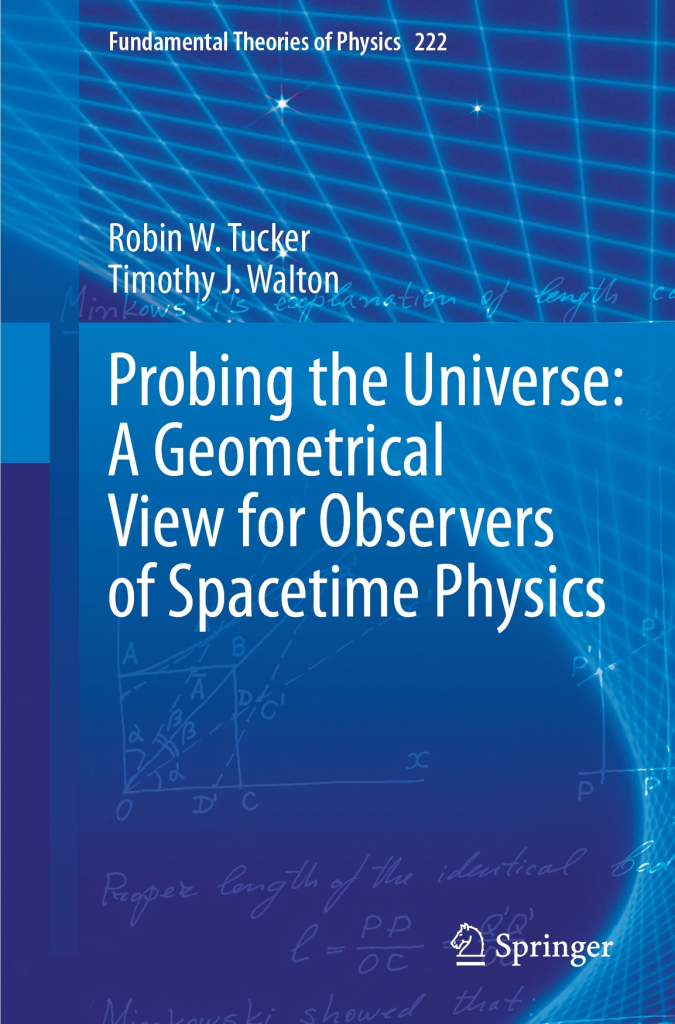
Last month saw the publication of “Probing the Universe: A Geometrical View for Observers of Spacetime Physics“, co-authored by Timothy Walton, Senior Lecturer in Applied Mathematics at the University of Lancashire, and Robin W. Tucker (Lancaster University), for the Springer-Nature “Fundamental Theories of Physics” book series.
A Focus on the Observer
Intended for postgraduate students with a background in mathematics or physics, the book develops a geometric description of Einstein’s General Theory of Relativity. It includes chapters that provide the rigorous mathematical detail of modern differential geometry, yet the focus remains primarily on what an observer actually “sees.” The text attempts to shift attention from purely symbolic equations toward the direct experience of those travelling through the Universe.
Mapping the Universe
The book traces the evolution of physics through a series of paradigms inspired by scientific history, from Aristotle and Euclid to the modern physics of Einstein and quantum mechanics. Because the roles of experiment and measurement are central to this work, we argue that we do not just study spacetime; we inhabit it. This perspective demonstrates how physical measurements—utilising light signals and clock synchronisations—shape our understanding of gravity and curvature. By guiding the reader through this “view from within,” the book shows how an observer’s local measurements construct a global map of the Universe.
Astrophysics at the JHI
Beyond the theoretical framework, the book applies geometric tools to the high-energy phenomena of modern astrophysics. It explores the complex environments surrounding black holes and the mechanics of astrophysical jets, providing a rigorous basis for understanding how matter and light behave in extreme gravitational fields. This focus aligns closely with ongoing research at the Jeremiah Horrocks Institute within the University of Lancashire which strives to connect mathematical theory with observational data. By examining the signatures of gravity in these violent cosmic settings, the book mirrors the Institute’s mission to advance our understanding of the Universe through both theoretical modelling and astronomical observation.
From Notes to Publication
What began as a set of informal research notes evolved into a massive undertaking during the UK’s COVID-19 lockdowns. “The project quickly grew in scale as we added the necessary detail and background to make the geometry truly accessible,” says co-author Timothy Walton. The book has already seen significant impact, with over 8,000 accesses on the Springer-Nature platform since its release in January. It stands as an essential resource for those seeking to bridge the gap between abstract blackboard mathematics and the practical observatory.
The book can be accessed and purchased at https://doi.org/10.1007/978-3-031-96452-7