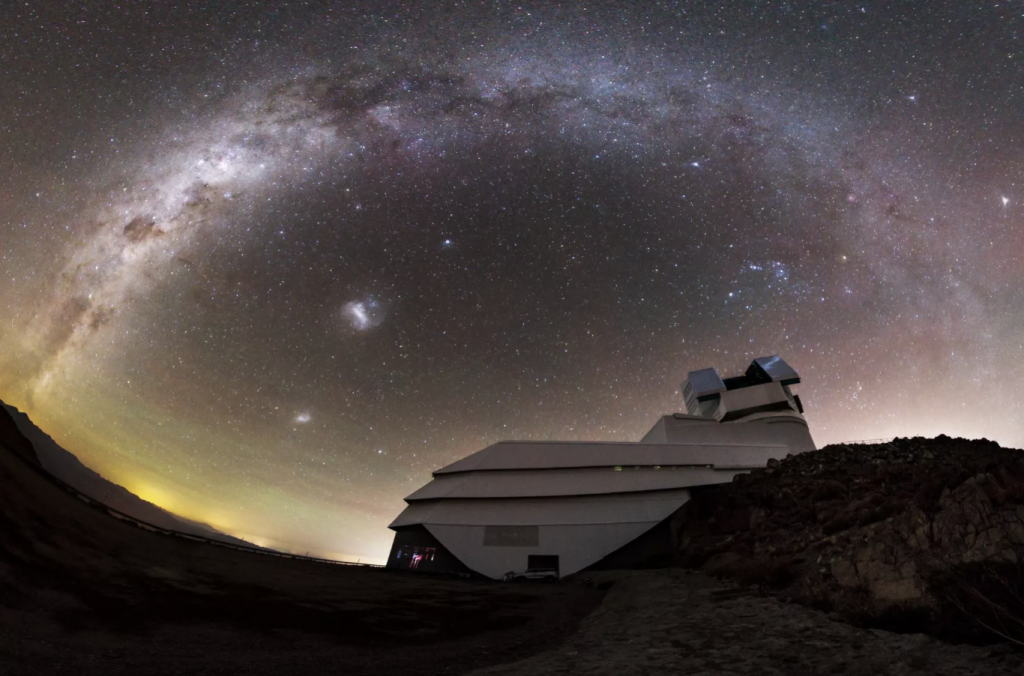
UK astronomers are celebrating the launch of the Rubin Legacy Survey of Space and Time (LSST) which began last night from a mountaintop in Chile. A milestone that the UK astronomy community has spent more than a decade preparing for, it’s the start of one of the most ambitious studies of the cosmos ever undertaken.
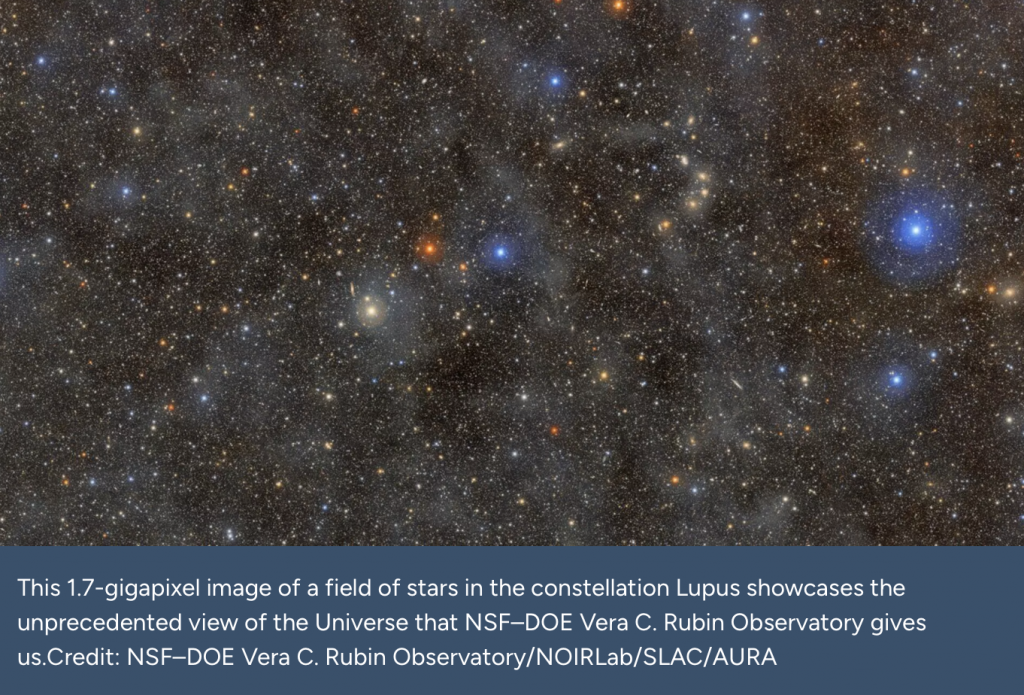
For the next ten years, the LSST will capture the entire southern sky to create an ultra-wide, ultra-high-definition time-lapse record of our Universe. This movie will help us solve some of the Universe’s biggest mysteries – such as the nature of dark energy, and the evolution of the solar system, Milky Way, and galaxies across cosmic time.
As a major international partner of the US-led Rubin Observatory, UK’s involvement is facilitated through a multi-million-pound investment by the Science and Technology Facilities Council (STFC). Formed in 2014, the LSST:UK Consortium is made up of 36 partner institutions representing all major UK astronomy research groups. Researchers and software developers across the UK are addressing scientific and technical challenges posed by this revolutionary observatory.
As part of the UK contribution, key innovations are expanding the scientific reach of the LSST. Professor Victor Debattista, from the University of Lancashire, has developed state-of-the-art models predicting how the stars of the inner Milky Way move, and continues to explore these as a function of age, which will be tested with the data coming from LSST.
He said: “We are looking forward to the vast datasets that will be coming from LSST, in particular regarding data on the bulge of the Milky Way. I have been involved in LSST since 2006 and 20 years later it is gratifying to start seeing the fruit of that preparation.”
At the University of Southampton, a team of astronomers has developed image-processing software that will uncover the kinds of distant and dust-shrouded galaxies and black holes that might be missed using LSST data alone.
Professor Manda Banerji, Professor of Astrophysics at the University of Southampton, leads a team that will fuse together Rubin data with infrared data from the Visible and Infrared Survey Telescope for Astronomy (VISTA) to allow some of the most distant galaxies and black holes to be found.
She said: “Distant objects slip out of the visible spectrum into the infrared, which means lots of exciting astronomical phenomena are not picked up in optical surveys such as LSST. Objects covered in dust that often appear faintly in optical surveys are also detected in the infrared.”
The software being developed by the Southampton team will be available to the public, allowing any astronomer, professional or amateur, to process data from their preferred telescope or camera through the LSST data-processing pipeline.
During its 10-year survey, Rubin will catalogue an estimated 17 billion stars, 20 billion galaxies, and millions of events that change in the sky – more objects than there are living people on earth. With the survey expected to create up to 500 petabytes of data in its lifetime, the UK is playing a significant role in the management and processing of this unprecedented dataset.
The UK’s LSST data facility will process 25% of the data from Rubin, turning raw images of the sky into the calibrated data products with which astronomers can do science, and will operate a science platform capable of supporting analysis of those data products by 20% of the international LSST community.
The UK’s LSST computing facility also hosts the Lasair event broker, a sophisticated software system supporting the near-real-time analysis of the alerts that Rubin issues whenever it detects a moving or time-varying celestial source. This alert stream – which can comprise millions of alerts per night and which includes a wide range of astrophysical objects, from nearby asteroids to distant supernovae – started flowing in February, ahead of today’s formal start of the 10-year LSST.
Professor Grahame Blair, Executive Director of Programmes at STFC, said: “Today marks the beginning of a new era in astronomy. Together with our partners, UK scientists, engineers and software experts, STFC is excited to be part of one of the most ambitious scientific projects ever undertaken.
“The discoveries made over the next decade will inspire future generations, deepen our understanding of the cosmos, and reinforce the UK’s position at the forefront of astronomical research.”
Professor Bob Mann, Professor of Survey Astronomy at the University of Edinburgh, is the Project Leader for UK participation in the Rubin LSST: He said: “Today marks the start of the 10-year LSST, but it is more like the mid-point of our UK project. Researchers in the UK have been preparing for more than a decade for the data that is starting to flow today and the contributions we are making will enhance the science that can be done with it over the coming decade or more by astronomers around the world.”
Professor Graham Smith, Professor of Physics and Astronomy at the University of Birmingham, said: “The beginning of Rubin’s LSST is a huge moment for everyone in the UK and around the world who is curious about how the universe works, and the fundamental laws of nature. This beautiful telescope and survey is 100 times more powerful for new discoveries than anything that has gone before, across the solar system, our own galaxy the Milky Way, galaxies and black holes in the distant universe, the most violent cosmic explosions, and mysteries such as dark matter and dark energy. I’m really excited to see what our early career researchers and students discover in the coming years with LSST data, and to share this with the public.”